UPS Sizing and Battery Runtime Calculations for Security Infrastructure
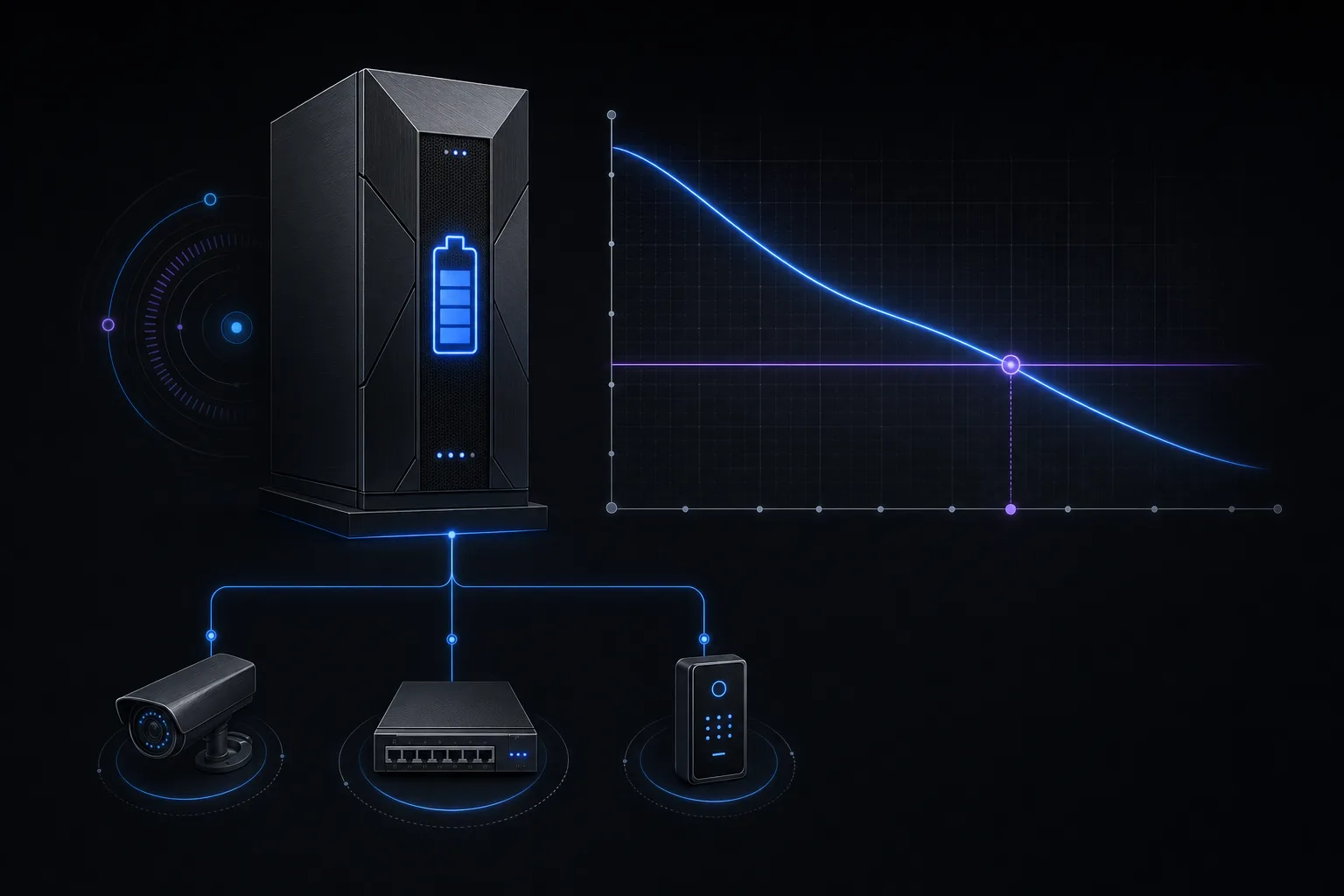
A security system that loses power is not a security system. It is a collection of dark screens, locked-out doors, and blind cameras at the precise moment someone chose to cut your utility feed. UPS (Uninterruptible Power Supply) sizing for security infrastructure is not the same exercise as protecting an office workstation. Security loads have unique characteristics: 24/7 operation, zero tolerance for dropout, inrush currents from PoE switches re-energizing cameras, and regulatory requirements that may mandate specific runtime durations.
This guide provides the engineering methodology for calculating UPS capacity and battery runtime for security systems. We will cover the electrical fundamentals that determine sizing, walk through a complete load calculation for a representative security system, compare battery technologies and UPS topologies, and address the monitoring and maintenance requirements that keep the system functional when you actually need it.
VA vs. Watts: Understanding Power Factor
UPS systems are rated in VA (volt-amperes) and watts. These are not the same number, and confusing them is the most common UPS sizing error. VA is apparent power: the product of voltage and current. Watts is real power: the energy actually consumed by the load. The ratio of watts to VA is the power factor (PF). A device rated at 100 VA with a power factor of 0.8 consumes 80 watts of real power.
Most UPS manufacturers rate their units at a power factor of 0.8 or 0.9. A "1500 VA / 900W" UPS can deliver 1500 VA or 900 watts, whichever limit is reached first. Security equipment power factors vary: PoE switches with active PFC (power factor correction) run at 0.95+, NVRs and servers at 0.85-0.95, and older analog CCTV equipment at 0.6-0.7. When calculating your load, you must account for both VA and watts to avoid oversizing on one dimension while undersizing on the other.
Typical Security Device Power Consumption
Accurate load calculation starts with knowing what each device actually draws, not what the nameplate says. Nameplate ratings represent maximum possible draw, but most devices operate well below their rated capacity. The following table provides realistic operating power draws based on thousands of field measurements across our installation base.
| Device | Typical Operating Draw | Nameplate Max | Notes |
|---|---|---|---|
| IP Camera (fixed, no heater) | 8 - 15W | 25.5W (PoE) | IR LEDs add 3-8W at night |
| IP PTZ Camera | 30 - 60W | 60-95W (PoE++) | Peak during rapid pan/tilt/zoom + heater |
| PoE Switch (24-port, managed) | 45 - 120W | 370-740W | Depends on actual PoE load; idle is ~45W |
| NVR (16-channel, 4 HDD) | 80 - 150W | 200-300W | HDD spinup draws peak current |
| NVR Server (enterprise, 16 HDD) | 250 - 500W | 750W | CPU load dependent; RAID rebuild peaks higher |
| Access Control Panel (2-door) | 15 - 25W | 40-50W | Lock power drawn from panel supply |
| Access Control Panel (8-door) | 40 - 70W | 100W | Varies with lock type (mag lock vs. strike) |
| Intercom Station | 10 - 18W | 25.5W (PoE) | Video intercom uses more |
| Fire Alarm Panel (addressable) | 3 - 8W (standby) | 5A @ 24VDC (alarm) | NAC circuits draw heavily in alarm (up to 120W) |
Runtime Calculation: A Worked Example
Let us size a UPS for a typical mid-size security closet containing the following equipment: one 24-port PoE switch feeding 16 IP cameras (actual PoE draw measured at 180W), one 16-channel NVR with 4 HDDs (measured at 130W), one 4-door access control panel with mag locks (measured at 55W), and one managed Ethernet switch for the backbone uplink (measured at 30W). The total operating load is 395 watts.
Step 1: Apply a 25% growth margin. 395W x 1.25 = 494W. This accounts for future cameras, firmware updates that increase processing load, and winter heater activation on outdoor cameras.
Step 2: Convert to VA using the lowest power factor among your devices. If the PoE switch has a PF of 0.95 and the NVR has a PF of 0.88, use 0.88 as the worst case: 494W / 0.88 = 561 VA.
Step 3: Select a UPS with rated capacity at least 25-30% above the calculated VA to avoid running the UPS above 70-75% load (which reduces battery life and increases heat generation). 561 VA / 0.70 = 801 VA minimum. A 1000 VA or 1500 VA UPS is the appropriate selection.
Step 4: Calculate runtime. Battery runtime is not linear with load. UPS manufacturers publish runtime curves, but the simplified formula is: Runtime (hours) = Battery Capacity (Wh) x Depth of Discharge x Inverter Efficiency / Load (W). For a typical 1500 VA line-interactive UPS with internal batteries rated at 432 Wh (two 12V/18Ah batteries: 12 x 18 x 2 = 432 Wh), using 80% depth of discharge and 90% inverter efficiency: (432 x 0.80 x 0.90) / 494 = 0.63 hours = approximately 38 minutes.
If the requirement is 2 hours of runtime (common for facilities without a generator), you need: 494W x 2 hours / (0.80 x 0.90) = 1,372 Wh of battery capacity. That requires an external battery pack or a UPS with extended battery options. Most rack-mount security UPS units support one or more external battery modules that add 400-1,000 Wh each.
Critical: Transfer Time for Security Equipment
Security equipment is highly sensitive to power interruptions. PoE switches drop all connected cameras during a power loss, and many cameras take 30-90 seconds to reboot and re-establish their video stream. NVRs with mechanical hard drives can suffer file system corruption from hard shutdowns. The UPS transfer time, the gap between utility failure and battery power engaging, must be under 10 milliseconds for security loads. Standby (offline) UPS units transfer in 5-12 ms, which is marginal. Line-interactive units transfer in 2-4 ms. Online double-conversion UPS units have zero transfer time because the load always runs from the inverter. For critical security infrastructure, online double-conversion is the recommended topology.
Battery Technologies Compared
The battery is the most failure-prone component in any UPS installation, and its selection has the greatest impact on total cost of ownership, maintenance burden, and reliability.
- VRLA AGM (Valve-Regulated Lead-Acid, Absorbed Glass Mat). The industry standard for security UPS applications. Sealed, maintenance-free, and available in a wide range of capacities. Typical lifespan is 3-5 years at 25°C (77°F), degrading significantly at higher temperatures (every 10°C above 25°C halves battery life per the Arrhenius equation). Cost is the lowest of any technology. The primary disadvantage is weight and the predictable degradation that requires proactive replacement before failure.
- Lithium Iron Phosphate (LiFePO4). Rapidly emerging as the preferred technology for security UPS applications. LiFePO4 batteries last 8-12 years (2-3x VRLA), weigh 60-70% less, tolerate higher temperatures without accelerated degradation, and support more charge/discharge cycles (2,000+ vs. 200-300 for VRLA). The upfront cost is 2-3x higher than VRLA, but the total cost of ownership over a 10-year period is typically 30-40% lower when factoring in avoided battery replacements. The battery management system (BMS) provides precise state-of-charge monitoring that VRLA cannot match.
- Nickel-Zinc (NiZn). A newer chemistry seeing limited adoption in telecom and security. NiZn offers high power density, fast recharge, and no thermal runaway risk. Lifespan is comparable to LiFePO4. The technology is still maturing in the UPS market, and product availability is limited compared to VRLA and LiFePO4.
UPS Topologies for Security
Centralized vs. distributed UPS placement is an architectural decision with significant implications for security system resilience. A centralized approach places one large UPS at the main electrical panel or MDF, protecting everything downstream. A distributed approach places smaller UPS units in each IDF closet or at each equipment location.
For security systems, the distributed model is almost always superior. A single centralized UPS does not protect against a power failure in a branch circuit breaker, a tripped GFCI, or a cable cut between the UPS and a remote IDF. Distributed UPS units at each closet provide localized protection regardless of what happens upstream. They also allow right-sizing: a closet with 2 cameras and a small switch gets a 750 VA unit, while the head-end closet with the NVR server gets a 3000 VA unit with extended batteries.
For generator-equipped facilities, the UPS provides ride-through power during the 10-30 second generator startup and transfer sequence. Ensure the UPS is rated for generator compatibility: generators produce voltage and frequency fluctuations during startup that can confuse the UPS into remaining on battery. Online double-conversion UPS units handle generator power cleanly because they always regenerate a clean sine wave from the inverter regardless of input quality.
Monitoring and Maintenance
A UPS that is not monitored is a UPS that will fail silently. Every UPS protecting security infrastructure should be monitored via SNMP (Simple Network Management Protocol) or dry contact closures integrated into the building management system or security platform. Critical alerts include: on-battery event, low battery warning, battery fault, overload condition, and high temperature. SNMP cards from APC, Eaton, and Vertiv support SNMPv3 with authentication and encryption, environmental monitoring (temperature and humidity sensors), and automated graceful shutdown of connected servers.
Battery testing per IEEE 1188 (Recommended Practice for Maintenance, Testing, and Replacement of VRLA Batteries) should be performed quarterly. Most UPS units support automatic self-test, which briefly transfers to battery and measures voltage under load. However, self-tests are not a substitute for periodic full-discharge tests that verify actual runtime. Annually, perform a controlled discharge test where the UPS runs on battery under representative load until it reaches the low-battery threshold. Document the actual runtime achieved and compare it to the design specification. When actual runtime drops below 80% of the original specification, it is time to replace the batteries.
Conclusion
UPS sizing for security infrastructure requires more rigor than plugging a number into a manufacturer's online calculator. You must measure actual loads (not nameplate ratings), account for growth, select the right topology and transfer time for your equipment, choose a battery technology that matches your maintenance capacity and lifecycle budget, and implement monitoring that alerts you to problems before a power event reveals them the hard way.
Zimy Electronics designs power protection systems as an integral part of every security installation. We measure actual load draws, calculate runtime requirements based on your facility's generator response time and risk profile, specify the appropriate UPS topology and battery technology, and integrate SNMP monitoring into our managed security platforms. From a single IDF closet to a multi-building campus, our engineering team ensures your security system stays online when the power does not.