Thermal vs. Optical: Choosing the Right Sensor for Substations
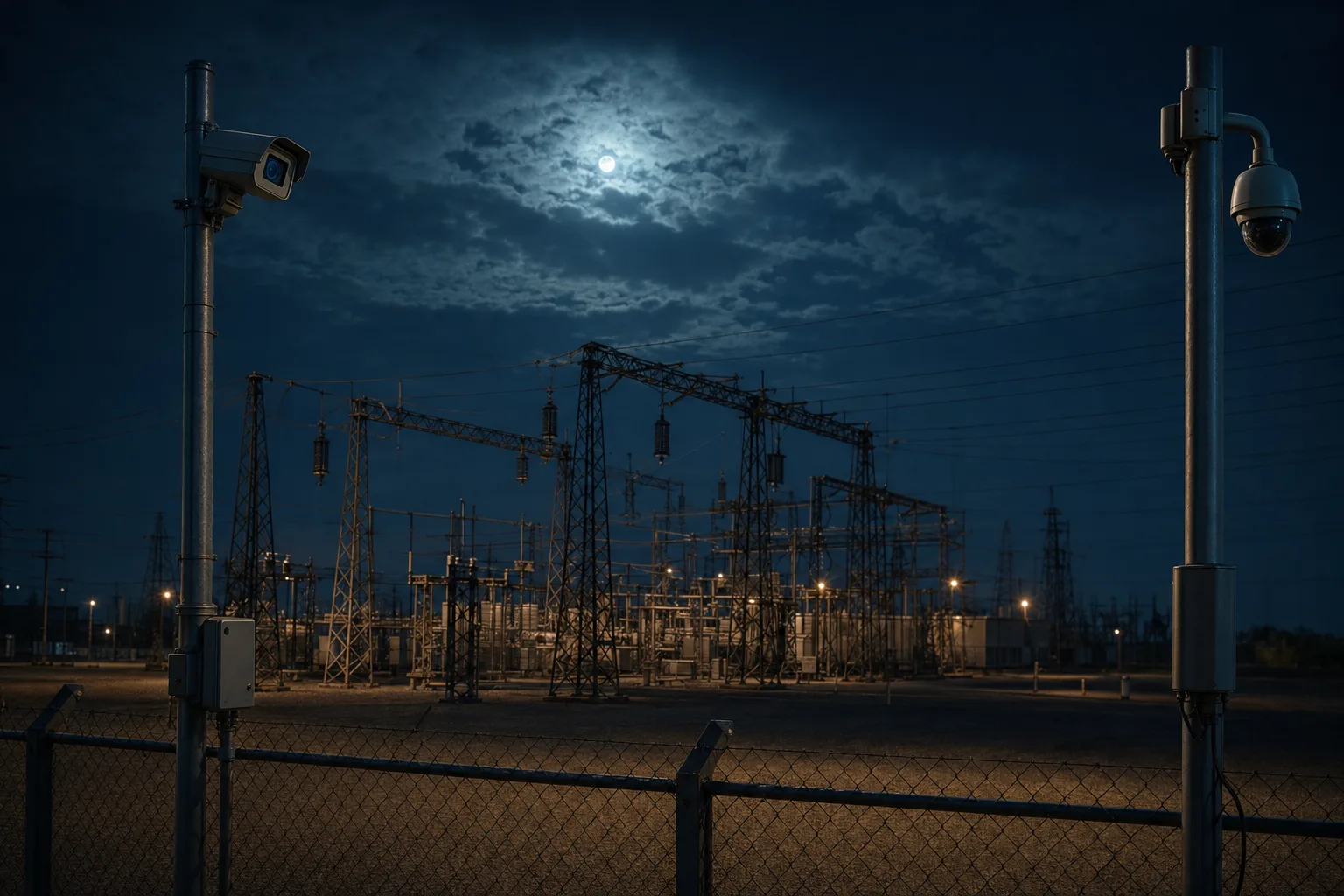
Substations are among the most challenging environments for security cameras. They are remote, unlit, exposed to extreme weather, and filled with electromagnetic interference. The choice between optical (visible light) cameras and thermal imaging sensors is not just a feature comparison. It is a fundamental design decision that determines whether your surveillance system will actually work when you need it most.
This article provides a direct comparison of both technologies in the context of substation security, explains why thermal sensors offer a critical dual-use advantage for predictive maintenance, and helps you determine the right mix for your deployment.
Why Visual Cameras Fail at Night
Standard optical cameras rely on reflected light to produce an image. During daylight hours, they produce excellent detail: color, texture, license plates, facial features. But most substations are unmanned, remote, and have no permanent lighting infrastructure. When the sun goes down, optical cameras face three critical limitations:
- IR illumination range. Built-in infrared LEDs on most cameras have an effective range of 30 to 50 meters. A substation perimeter may extend 200 meters or more. The edges of the scene are completely dark.
- IR reflection problems. Infrared illumination reflects off metal surfaces, which substations have in abundance: transformers, bus bars, fencing, and equipment enclosures. This creates glare, washout, and false reflections that confuse both operators and analytics.
- Environmental interference. Fog, rain, dust, and snow scatter IR light and degrade image quality dramatically. A camera that performs well on a clear night may be essentially blind during a storm, which is exactly when an attacker might choose to strike.
Real-World Failure
In a 2023 incident at a rural substation, optical cameras with 50m IR range captured clear footage of a perimeter breach point, but the intruders had entered from 120 meters away and were never detected until they reached the transformer pad. The entire approach path was outside the camera's effective night range.
Radiometric Thermal Sensors
Thermal cameras detect emitted infrared radiation (heat) rather than reflected light. Every object above absolute zero emits thermal energy, and thermal sensors create images based on temperature differences between objects and their surroundings. This means they work equally well in complete darkness, through fog, and in most weather conditions.
Radiometric thermal cameras go a step further. Unlike basic thermal cameras that only display a heat image, radiometric sensors measure the actual temperature of every pixel in the scene. This data can be used to set temperature alarms, track thermal trends over time, and feed into analytics engines that trigger alerts when specific temperature thresholds are exceeded.
- No illumination required. Thermal cameras produce clear images in total darkness without any supplemental lighting, eliminating the range limitations of IR LEDs.
- Weather penetration. Thermal imaging cuts through fog, light rain, and dust far more effectively than visible light or near-IR illumination.
- Human detection at range. A person's body heat creates a strong thermal contrast against ambient backgrounds, making detection reliable at distances of 500 meters or more with the right lens.
- Camouflage defeat. Thermal cameras see through concealment that would fool optical cameras. Dark clothing, face coverings, and hiding behind bushes do not mask a person's heat signature.
Dual-Use: Security and Predictive Maintenance
The most compelling advantage of radiometric thermal cameras in a substation environment is their dual-use capability. The same camera that detects intruders at the perimeter at night can monitor transformer temperatures during the day. This convergence of physical security and operational technology creates a force multiplier that justifies the higher upfront cost.
Radiometric thermal cameras can be configured to continuously monitor critical equipment and trigger alarms when temperatures exceed defined thresholds. Common use cases include:
- Transformer overheating. Detect rising core temperatures weeks before a failure occurs, enabling planned maintenance instead of emergency response.
- Bushing and connector hotspots. Loose connections and degraded bushings generate excess heat. Thermal monitoring catches these issues before they cause arc flash or outages.
- Breaker anomalies. Circuit breakers under stress show thermal signatures that indicate impending failure. Catching this early prevents cascading grid failures.
ROI Insight
A single prevented transformer failure can save $500,000 to $2,000,000 in replacement costs and lost revenue. When factored against the incremental cost of radiometric thermal cameras over standard optical units ($3,000 to $8,000 per camera), the ROI is often achieved within the first prevented incident.
Cost Comparison
Thermal cameras carry a higher per-unit cost than optical cameras, but the total cost of ownership tells a different story when you factor in infrastructure and operational savings:
Per-Camera Cost Comparison
| Factor | Optical + IR | Radiometric Thermal |
|---|---|---|
| Camera Unit | $800 - $2,500 | $4,000 - $12,000 |
| IR Illuminators | $500 - $2,000 | Not needed |
| Lighting Infrastructure | $2,000 - $10,000 | Not needed |
| Predictive Maintenance | Separate system needed | Built in |
| Night Detection Range | 30 - 50m | 500m+ |
Recommended Approach: Hybrid Deployment
For most substation deployments, the optimal solution is a hybrid approach that combines both sensor types. Thermal cameras handle perimeter detection and equipment monitoring, while optical cameras provide the high-resolution detail needed for identification and forensic review at key points like gates, equipment access panels, and control house entries.
A typical substation might deploy four thermal cameras covering the full perimeter with overlapping fields of view, plus two to four optical cameras at access points where facial recognition or license plate capture is needed. This approach delivers comprehensive coverage at a lower total cost than attempting to cover the entire site with either technology alone.
Conclusion
For substation security, thermal imaging is not a luxury upgrade. It is a necessity for reliable nighttime detection and a strategic investment when leveraged for predictive maintenance. The dual-use capability of radiometric sensors transforms a security expense into an operational asset that protects both physical infrastructure and grid reliability.
At Zimy Electronics, we design hybrid thermal and optical surveillance systems specifically for utility environments. Zimy Electronics specializes in sensor selection, camera layout design, and thermal data integration with existing SCADA or asset management systems.