Power over Ethernet Budget Planning for Enterprise Security Systems
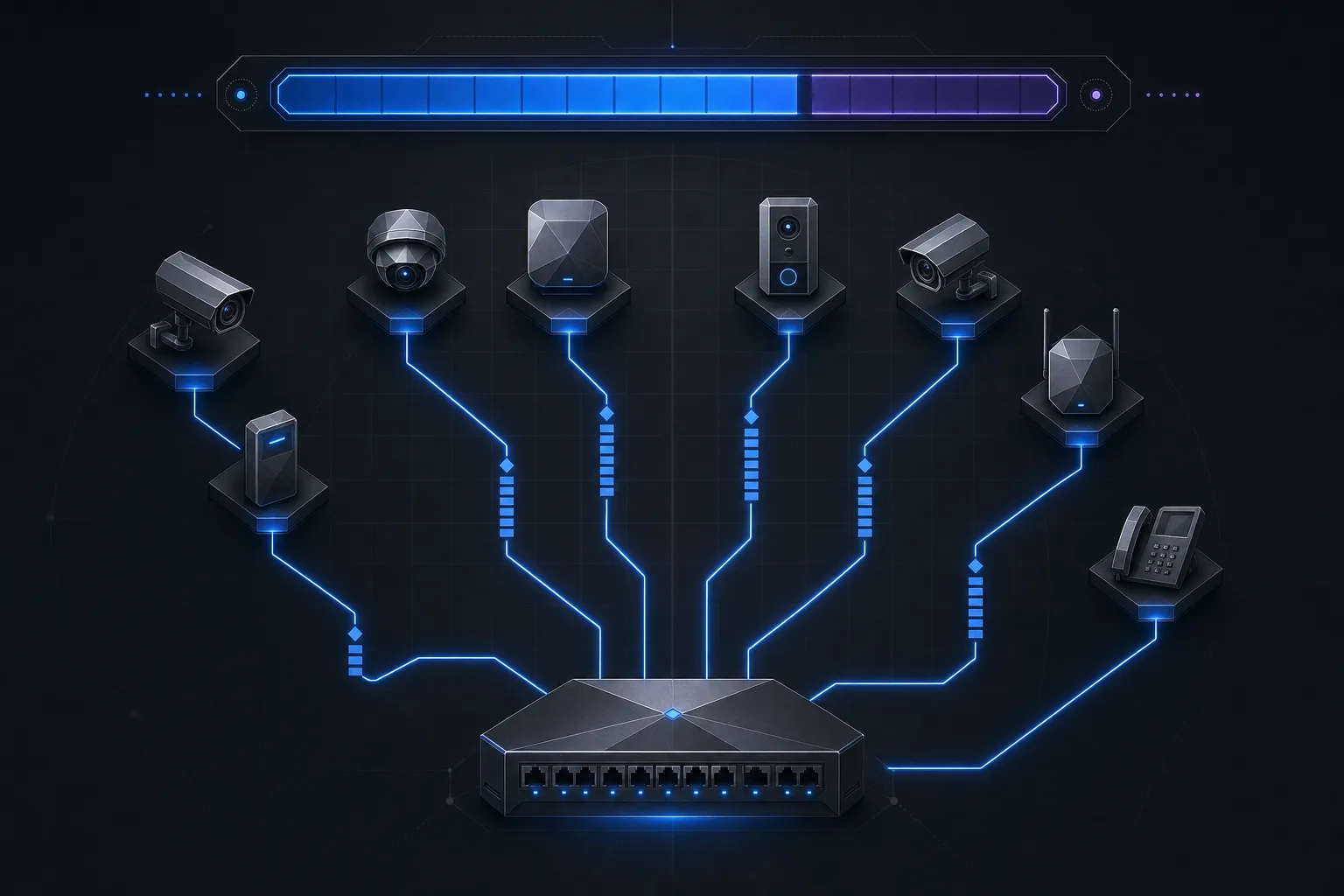
Power over Ethernet has become the circulatory system of modern IP security deployments, delivering both data and DC power over a single structured cabling run to cameras, intercoms, access control readers, and wireless access points. Yet despite its ubiquity, PoE budget planning remains one of the most frequently miscalculated elements in system design. Underprovisioned switches lead to cameras dropping offline under load, while over-provisioned infrastructure wastes capital that could be allocated to higher-resolution sensors or deeper storage.
This article walks through the IEEE PoE standards in detail, explains how to perform accurate power budget calculations for real-world security deployments, and addresses the environmental and cabling factors that silently erode delivered wattage. Whether you are designing a 16-camera retail system or a 500-device campus deployment, the principles here will keep your PoE infrastructure reliable for years.
The IEEE PoE Standards: From 15.4W to 90W
The IEEE has ratified four major PoE standards since 2003, each increasing the available power envelope. Understanding these standards is not optional for security integrators because the standard determines which devices a switch port can power, how many pairs carry current, and what negotiation protocol is used.
| Standard | Common Name | Max PSE Output | Max PD Input | Pairs Used | Cable Class |
|---|---|---|---|---|---|
| 802.3af (2003) | PoE / Type 1 | 15.4 W | 12.95 W | 2 pairs | Cat5e minimum |
| 802.3at (2009) | PoE+ / Type 2 | 30 W | 25.5 W | 2 pairs | Cat5e minimum |
| 802.3bt Type 3 (2018) | PoE++ / 4PPoE | 60 W | 51 W | 4 pairs | Cat5e minimum |
| 802.3bt Type 4 (2018) | PoE++ / 4PPoE | 90 W | 71.3 W | 4 pairs | Cat6A recommended |
Notice the gap between PSE (Power Sourcing Equipment) output and PD (Powered Device) input. That delta is not a rounding error; it is the power dissipated as heat in the cable itself. At 100 meters of 24 AWG Cat5e, resistive losses consume roughly 15-20% of the sourced power. This is the single most important number that gets ignored in napkin-math PoE budgets.
Performing Accurate Power Budget Calculations
The fundamental equation is deceptively simple: Total PoE Budget of the switch must exceed the sum of all connected PD maximum power draws, plus a safety margin. In practice, calculating the right side of that equation requires nuance. A fixed dome camera with IR illumination may draw 12W in daytime but spike to 25W at night when the LEDs activate. A PTZ camera with a heater and wiper can pull 60W during a cold-weather preset tour. You must design for the worst-case simultaneous load, not the average draw.
Start by inventorying every powered device and recording its maximum rated power consumption from the manufacturer datasheet, not the typical draw. Multiply the total by a 1.2x safety factor to account for future device additions and firmware updates that may increase power draw. This 20% headroom is an industry best practice endorsed by both BICSI and most switch manufacturers.
Real-World Budget Example
Consider a 48-port PoE+ switch with a 740W total PoE budget. If you connect 48 fixed cameras each drawing 15.4W at peak, your total load is 739.2W. On paper that fits. In reality, you have zero headroom and the switch will begin power-cycling lower-priority ports the moment ambient temperature rises or a single camera spikes. A better design would cap at 38-40 cameras per switch, reserving capacity for priority devices and environmental derating.
Midspan Injectors vs. Endspan Switches
PoE power sourcing equipment comes in two forms: endspan devices (PoE switches with built-in PSE circuitry on every port) and midspan injectors (standalone units that patch between a non-PoE switch and the device). Each has a role in security system design.
- Endspan switches are the default choice for new installations. They reduce cable plant complexity, provide per-port power management through SNMP and LLDP-MED, and enable features like scheduled PoE power cycling for camera reboots. Enterprise-grade switches from Cisco, Juniper, and Aruba offer granular power policing and priority classes.
- Midspan injectors are ideal for retrofit projects where an existing non-PoE switch is in place and operational. They also allow you to add 802.3bt Type 3/4 power to older switches that only support 802.3af. High-quality midspan units from manufacturers like Microsemi (now Microchip) offer per-port power management comparable to endspan switches.
- Avoid single-port injectors for deployments exceeding 4-5 cameras. They create a tangle of wall-wart power supplies in the IDF, each one an unmanaged single point of failure with no remote monitoring capability. They also bypass any UPS protection unless individually connected.
LLDP-MED Negotiation and Per-Port Power Allocation
Link Layer Discovery Protocol for Media Endpoint Devices (LLDP-MED) is the mechanism by which a powered device communicates its actual power requirements to the switch. Without LLDP-MED, the switch must allocate the full class maximum to each port. A Class 4 device (802.3at) would receive a 30W reservation even if it only needs 18W. Across 48 ports, that overallocation can waste hundreds of watts of budget capacity.
When LLDP-MED is properly supported on both the switch and the camera, the PD advertises its actual maximum draw, and the PSE allocates only that amount. This is called dynamic power allocation, and it is the single most effective way to stretch a switch's PoE budget. Verify LLDP-MED support on every camera model during the submittal phase. Some budget cameras implement only basic resistive classification and will always consume the full class allocation from the switch's perspective.
For 802.3bt Type 3 and Type 4 devices, LLDP-MED negotiation is mandatory. The higher power levels cannot be delivered without Layer 2 classification. This is a critical design consideration when selecting PTZ cameras with integrated IR illuminators or PoE-powered LED strobes for parking structures.
Cable Distance Derating and Temperature Effects
The 100-meter maximum for Ethernet is a data transmission limit, but PoE delivery degrades continuously with distance and temperature. Every meter of copper adds resistance, and resistance converts electrical energy to heat. At elevated ambient temperatures, such as those found in ceiling plenums, attics, and outdoor conduit exposed to direct sun, copper resistance increases further.
TIA-568.2-D specifies that horizontal cable operating above 20 degrees Celsius must have its channel length derated. For every degree above 20C, the maximum channel length decreases. In a plenum space that reaches 45C, which is common in the southern United States during summer, the effective cable distance drops to approximately 79 meters for Cat6 and 85 meters for Cat6A. This means a camera installed at 90 meters may work perfectly in winter and fail every summer afternoon.
For 802.3bt Type 4 deployments at 90W, the current flowing through all four pairs generates significant heat within cable bundles. The TIA TSB-184-A technical bulletin recommends reducing bundle sizes or increasing conduit diameter when running PoE to more than 50% of cables in a bundle. Cat6A with its larger 23 AWG conductors dissipates less heat per watt than Cat5e's 24 AWG conductors, which is why Cat6A is strongly recommended for any Type 3 or Type 4 deployment, not for bandwidth reasons, but for thermal performance.
Managed PoE Switch Selection for Security Systems
Not all PoE switches are created equal, and the security integrator must evaluate several attributes beyond port count and total PoE budget.
- Per-port PoE priority: Enterprise switches allow you to assign priority levels (critical, high, low) to each port. When total draw approaches the budget ceiling, the switch sheds low-priority ports first. Assign critical priority to PTZ cameras covering primary entry points and perimeter zones.
- PoE watchdog / auto-recovery: This feature monitors link status and automatically power-cycles a port if the connected device stops responding. For cameras mounted 40 feet up on a pole, this eliminates a truck roll for a simple reboot.
- PoE scheduling: Some deployments benefit from powering cameras on and off on a schedule. Interior office cameras in a facility that only operates Monday through Friday can be powered down on weekends, extending device lifespan and reducing unnecessary recording.
- Redundant power supplies: A switch powering 48 security cameras is a single point of failure for 48 video feeds. Specify switches with dual hot-swappable power supplies and connect each to a separate UPS circuit.
What Happens When You Oversubscribe a PoE Switch
Oversubscription occurs when the total power demand from connected PDs exceeds the switch's PoE power budget. The behavior is vendor-specific but generally follows one of two patterns. Most enterprise switches will deny power to the newest device plugged in, refusing to enable PoE on the port and logging an alarm. This is the safe mode. Some lower-cost switches, particularly unmanaged models marketed to the security industry, will attempt to power all devices and brown out, leading to intermittent reboots across multiple cameras simultaneously. The result on the VMS is a cascading series of camera disconnections that is difficult to diagnose without examining the switch's power draw logs.
Oversubscription is particularly dangerous in security systems because it tends to manifest during the exact conditions when cameras are most needed. IR illuminators activate at dusk, heaters engage during cold snaps, and PTZ cameras begin preset tours during high-traffic periods. Each of these events increases power draw simultaneously. Design the budget for the worst five minutes, not the average day.
Designing PoE Infrastructure That Lasts
A well-designed PoE infrastructure is invisible. Cameras power up, stay up, and the security operations team never thinks about the switch behind the wall. Achieving that requires disciplined power budget calculations with real datasheets, honest environmental derating, LLDP-MED validation, and switch selection that accounts for worst-case load scenarios. Shortcuts in PoE planning create reliability problems that haunt the integrator for the life of the service contract.
Zimy Electronics designs every PoE deployment with full power budget analysis, environmental derating calculations, and managed switch configurations that include per-port priority, watchdog recovery, and SNMP monitoring. From eight-camera retail systems to multi-building campus deployments, our engineering team ensures your IP security infrastructure has the power headroom to perform reliably in every condition.