Global Logistics Hub: 5M sq ft Secured
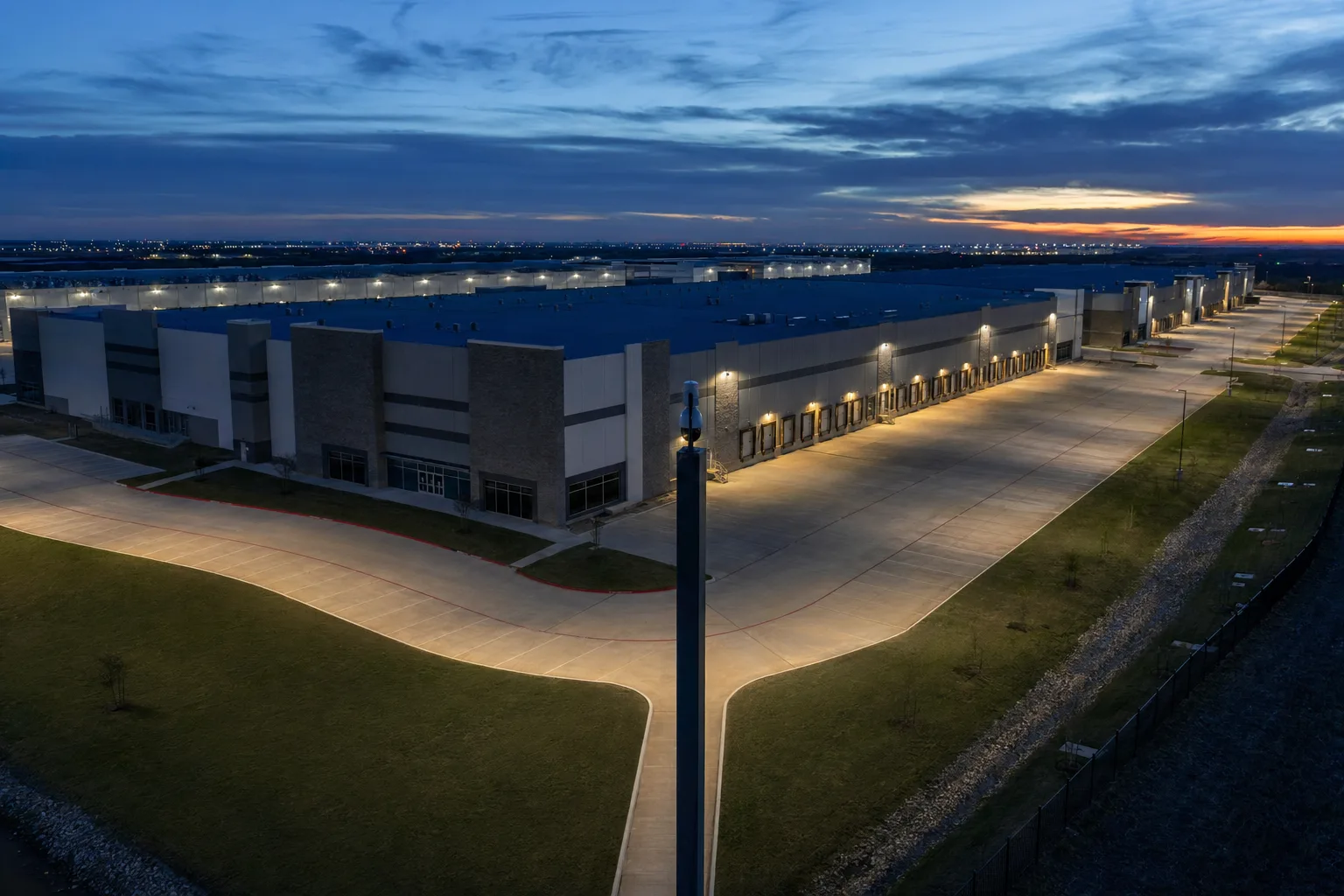
Project Snapshot
- Operator: Fortune 500 Global Logistics Provider
- Industry: Warehousing & Distribution
- Campus Size: 5,000,000+ sq ft across 12 facilities
- Location: Greater Houston Metro Area, Texas
- Cameras: 2,147 IP cameras deployed
- Access Points: 340 controlled doors
- Timeline: 14-month phased rollout
- VMS Platform: Genetec Security Center 5.12
Executive Summary
A Fortune 500 logistics company operating a sprawling multi-facility campus outside Houston faced a critical mandate: unify twelve separate warehouses, each running its own siloed security system, into a single centralized platform capable of real-time monitoring, AI-driven analytics, and seamless integration with their warehouse management system (WMS).
Over fourteen months, the project team designed and deployed a converged security architecture encompassing 2,147 IP cameras, 340 access-controlled doors, a 10-gigabit fiber backbone, and an AI analytics layer purpose-built for logistics operations. The result was a 40% reduction in shrinkage, a 60% improvement in incident response time, and a unified command center that gave the client total visibility across every square foot of their operation for the first time in the company's history.
The Challenge
The client's campus had grown organically over two decades. Each of the twelve facilities had been built at different times, by different contractors, using different security vendors. Building 1 ran an aging Pelco analog DVR system with coaxial cabling. Buildings 3 through 5 used Milestone XProtect with a mix of Axis and Hikvision cameras. The newest buildings (10-12) had standalone Verkada cloud cameras with no integration to anything else. Access control was equally fragmented: some buildings used legacy HID ProxPoint II readers with a Lenel OnGuard server, while others had basic standalone keypads.
The result was operational chaos. The security team had to monitor nine different video clients, four access control platforms, and had zero ability to correlate events across buildings. When an incident occurred at a loading dock in Building 7, operators had to physically walk to that building's control room to pull footage. There was no unified alarm management, no centralized credential database, and no analytics of any kind.
Key Pain Points Identified During Discovery
- No unified view: Security operators managed 9 separate video clients across 12 buildings, leading to an average incident response time of 22 minutes.
- Credential sprawl: Over 4,200 active keycards existed across four different access control systems with no centralized revocation capability. Former employees retained access for an average of 11 days after termination.
- Shrinkage losses: The client was losing an estimated $3.2 million annually to theft, misplacement, and unaccounted inventory discrepancies across loading docks.
- Analog infrastructure: Buildings 1 and 2 still ran analog cameras on coaxial cable, producing 480p footage that was essentially useless for evidentiary purposes.
- Network limitations: No dedicated security VLAN existed. Camera traffic competed with WMS, VoIP, and general IT traffic on flat Layer 2 networks.
Beyond the technical challenges, the client faced regulatory pressure. Their contracts with several Fortune 100 retail clients required documented security standards, including 30-day video retention at all shipping and receiving areas, controlled access to high-value storage zones, and the ability to provide investigation footage within four hours of a request. The existing infrastructure could not reliably meet any of these requirements.
The Solution
Zimy's engineering team spent six weeks on-site conducting a comprehensive facility assessment before presenting the solution architecture. The design philosophy centered on three pillars: unification, scalability, and intelligence. Every component was selected to serve all three.
Solution Architecture: Genetec Security Center
Genetec Security Center 5.12 was selected as the unified platform for several reasons. First, its open architecture allowed federation of existing Milestone systems in buildings that had newer cameras, avoiding a costly rip-and-replace in those locations. Second, Genetec's Synergis access control module provided native integration between video and door events, eliminating the need for middleware. Third, the platform's AutoVu license plate recognition module was critical for the client's loading dock operations.
The architecture was deployed as a distributed system with a primary Directory server at the central command center and Archiver servers in each building for local recording redundancy. If the WAN link between buildings failed, each building would continue recording locally and sync metadata back to the central server upon reconnection. This design ensured zero footage loss even during network outages.
Server Infrastructure
- 1x Directory Server: Dell PowerEdge R750, dual Xeon Gold 6342, 256GB RAM, Windows Server 2022. Central management and federation point.
- 12x Archiver Servers: Dell PowerEdge R750 with 8x 18TB enterprise SATA drives in RAID 6 per unit, providing approximately 130TB usable per building. 30-day retention at H.265 encoding.
- 2x Failover Servers: Hot standby Archiver servers configured for automatic failover, each covering six buildings.
- 1x Analytics Server: Dell PowerEdge R750xa with NVIDIA A30 GPU, dedicated to AI-driven analytics processing for loading dock and perimeter cameras.
Camera Selection Strategy
Rather than selecting a single camera manufacturer, Zimy took a best-of-breed approach, matching camera capabilities to specific use cases. This is a hallmark of our open-architecture philosophy: no single vendor excels at every scenario, and locking into one brand always means compromising somewhere.
Camera Mix by Application
Network Backbone: 10G Fiber Ring
The existing inter-building network consisted of a hub-and-spoke topology with 1G copper links between buildings, all converging on the IT data center in Building 1. This was wholly inadequate for the bandwidth demands of 2,100+ IP cameras generating a combined throughput of approximately 12 Gbps at peak.
Zimy designed and installed a 10-gigabit fiber ring connecting all twelve buildings in a redundant loop topology. We used Corning single-mode OS2 fiber in 144-strand armored cable, run through existing underground conduit between buildings, with fusion splicing at each building's MDF. The ring was built on Cisco Catalyst 9300X switches with 10G SFP+ uplinks, configured with Rapid Spanning Tree Protocol (RSTP) for sub-second failover in the event of a fiber cut.
Within each building, the design called for dedicated security VLANs on Cisco Catalyst 9200 PoE+ switches, providing 30W PoE per port for cameras and 60W PoE++ for PTZ units. The network was fully segmented: camera traffic lived on VLAN 100, access control on VLAN 110, and management traffic on VLAN 120. Inter-VLAN routing was handled by Layer 3 switches with access control lists (ACLs) restricting which devices could communicate across VLANs.
Network Design Highlights
- 144-strand Corning OS2 single-mode fiber ring with armored jacket in underground conduit
- 10G SFP+ uplinks between all buildings with RSTP failover (sub-500ms convergence)
- Dedicated security VLANs with ACL-based micro-segmentation isolating camera, access control, and management traffic
- 802.1X port authentication on all camera ports, preventing unauthorized device connections
- Multicast streaming configuration reducing backbone utilization by 35% compared to unicast
- QoS policies prioritizing video traffic over general data, ensuring consistent stream quality
Unified Access Control
The access control migration was one of the most operationally sensitive phases of the project. The client could not afford any downtime at controlled doors, and 4,200 active cardholders needed to be migrated without issuing new credentials. Zimy's approach was surgical.
We standardized on Genetec Synergis with Mercury LP intelligent controllers at each building. The Mercury hardware was selected because it supports virtually every major card format, allowing us to read existing HID iCLASS SE credentials during the transition period while simultaneously supporting the client's eventual migration to SEOS mobile credentials. Each door was equipped with HID Signo readers, which are backward-compatible with the existing card population while being ready for Bluetooth mobile credentials.
The migration was performed building by building. On each cutover night, Zimy technicians installed the Mercury controllers, wired them to the existing locks and REX sensors, enrolled the existing credentials into the Synergis database, and tested every door before sunrise. The legacy systems were decommissioned only after a 72-hour parallel-run period confirmed zero access failures. The entire 340-door migration was completed in nine weeks with zero access interruptions.
Integration with Warehouse Management System
One of the most innovative aspects of this deployment was the bidirectional integration between Genetec Security Center and the client's warehouse management system (Manhattan Associates WMS). Zimy's software engineering team developed a custom integration using Genetec's Web SDK and Manhattan's REST API that enabled several powerful workflows.
When a shipment was scanned at a loading dock, the WMS triggered a bookmark in the video system, tagging the exact camera and timestamp associated with that shipment. If a discrepancy was later discovered during inventory reconciliation, the loss prevention team could search by shipment ID and immediately pull up the video of that specific trailer being loaded or unloaded. This capability alone reduced investigation time from an average of three hours to under twelve minutes.
The integration also worked in reverse. When the video analytics system detected unauthorized activity at a dock (for example, a trailer being accessed outside scheduled hours), it sent an alert to the WMS that automatically placed a hold on the associated inventory, preventing it from being shipped until the security team cleared the event.
AI Analytics for Loading Dock Monitoring
The client identified loading dock shrinkage as their highest-priority loss vector. Traditional approaches relied on security officers physically monitoring dock activity, which was impractical across 48 active docks operating around the clock. Zimy deployed a layered AI analytics solution combining edge-based analytics on the cameras themselves with server-side deep learning for more complex pattern recognition.
Analytics Capabilities Deployed
- Object Classification: Edge-based analytics on Axis cameras classified people, vehicles, and forklifts, dramatically reducing false alarms from wildlife, wind-blown debris, and shadow movement.
- License Plate Recognition: Genetec AutoVu captured and logged every vehicle entering and exiting the campus, cross-referencing against an approved carrier list from the WMS.
- Loitering Detection: Server-side analytics flagged individuals remaining in dock staging areas for more than a configurable threshold (default: 10 minutes) without scanning activity.
- Tailgating Detection: At controlled access points, analytics identified when multiple individuals passed through a door on a single credential swipe.
- After-Hours Activity: Any motion detected in warehouse aisles or dock areas outside scheduled operating hours generated priority alerts to the command center and on-call security manager.
The analytics pipeline processed approximately 6 terabytes of video data per day. The NVIDIA A30 GPU in the analytics server handled real-time inference on 120 concurrent streams, with remaining cameras processed on a rotating basis during off-peak hours. Analytics metadata was stored in a PostgreSQL database, providing the loss prevention team with rich search capabilities including heatmaps, occupancy trends, and dwell-time analysis.
The Results
The system has been fully operational for eight months at the time of writing. The quantitative results have exceeded the client's initial projections.
The shrinkage reduction translated to approximately $1.28 million in annual savings, meaning the entire security infrastructure investment achieved a return-on-investment payback period of approximately 3.4 years. When factoring in the operational efficiency gains (reduced security headcount needed per shift, elimination of manual video export requests, and faster customer claims resolution), the effective payback period dropped to under 2.5 years.
The unified access control system eliminated the credential revocation gap entirely. When an employee is terminated in the client's HR system, their access credentials are now revoked across all 340 doors within fifteen minutes via an automated API integration. The previous average of eleven days of residual access has been reduced to near-zero.
The WMS integration has become one of the most valued features. The client's loss prevention team reports that the ability to search video by shipment ID has transformed their investigative process. Customer claims that previously required days of manual footage review are now resolved within hours, leading to faster insurance reimbursements and improved relationships with retail partners.
Client Testimonial
"Before Zimy, our security operation was reactive. We'd find out about a problem days or weeks after it happened, and half the time the footage was either gone or unusable. Now we have a single pane of glass across all twelve buildings, and our analytics are catching issues before they become incidents. The WMS integration was the game-changer we didn't know we needed."
-- Director of Loss Prevention, Client Organization
Lessons Learned
Every large-scale deployment teaches the integrator as much as the client. Here are the key takeaways from this engagement that inform our approach to similar projects.
- Invest heavily in the discovery phase. The six weeks we spent assessing every building before drafting the design saved us months of change orders later. We documented every conduit run, every cable pathway, every electrical panel, and every existing device. This upfront investment paid for itself many times over during installation.
- Build the network first. The fiber ring and switch infrastructure was installed before deploying a single camera. This allowed us to validate bandwidth capacity, VLAN segmentation, and multicast behavior under controlled conditions before adding 2,100 endpoints to the network.
- Phase access control cutovers carefully. Migrating 340 doors across 12 buildings required meticulous coordination with operations. We performed all cutovers between 10 PM and 6 AM, maintained a rollback plan for every door, and kept the legacy system running in parallel for 72 hours. Zero doors were left unsecured at any point.
- Budget for storage growth. The storage architecture was designed with 30% headroom above the initial retention requirements. Within six months, the client requested extended retention in high-value zones (from 30 days to 90 days), and we were able to accommodate this without hardware additions.
- Train the operators, not just the administrators. We provided 120 hours of hands-on training across three shifts of security operators, plus a separate track for the IT team and loss prevention investigators. The best technology in the world is useless if the people using it daily are not proficient.
- Plan for analytics tuning. AI analytics are not a set-and-forget deployment. We spent four weeks after go-live fine-tuning detection zones, sensitivity thresholds, and alert routing. The initial false alarm rate of 15% was reduced to under 3% through iterative calibration with the client's security team.
Project Timeline
Conclusion
This project demonstrates what is possible when physical security is treated as a strategic infrastructure investment rather than a cost center. By unifying video surveillance, access control, and AI analytics on a single platform, and integrating that platform with the client's core business systems, the deployment transformed the security operation from a reactive liability into a proactive business intelligence tool.
A deployment of this scale — 2,147 cameras, 340 doors, and 12 buildings — demands meticulous planning, flawless execution, and ongoing optimization. The technology is only as good as the architecture behind it and the discipline applied during installation and commissioning.
The deployment operates under a five-year service agreement that includes firmware management, analytics tuning, and 24/7 technical support — ensuring the system continues to deliver ROI well beyond the initial rollout.