Firestopping Penetrations: The Requirement Nobody Gets Right
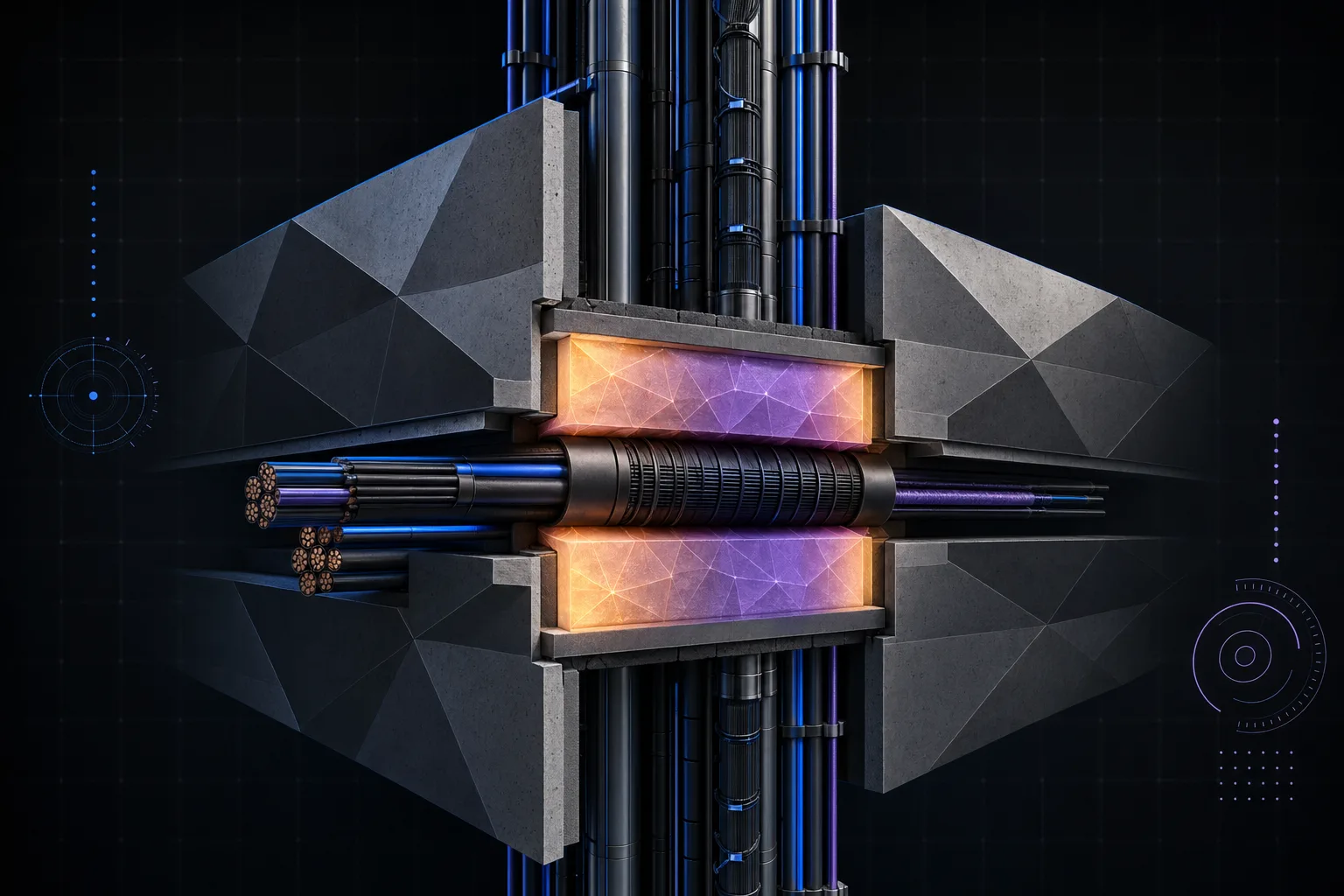
Of all the code requirements that affect low-voltage installations, firestopping is the one most consistently botched. It is not because the requirements are ambiguous; UL 1479 and the International Building Code are explicit about what constitutes a compliant through-penetration firestop system. It is because, in the field, firestopping is treated as an afterthought: something that gets a bead of red caulk squeezed into a hole at the end of a project, if it gets addressed at all. That approach fails inspections, fails in fires, and exposes integrators and building owners to staggering liability.
This article explains the firestopping standards, the listed system requirements, the common violations that inspectors find, and the proper procedures for maintaining fire-rated assemblies when low-voltage cables penetrate them. If you install cable through any fire-rated wall, floor, or ceiling, this information is not optional.
UL 1479 and ASTM E814: The Testing Standards
All through-penetration firestop systems in the United States are tested to UL 1479 (ASTM E814), "Fire Tests of Penetration Firestops." This standard subjects a firestop assembly to a fire on one side of the barrier for a specified duration (typically 1 to 3 hours, matching the fire rating of the barrier) and measures two things: whether fire passes through the penetration, and whether the unexposed side reaches dangerous temperatures.
The test yields two ratings. The F-rating indicates how long the firestop prevents flame passage through the penetration. The T-rating indicates how long the unexposed side stays below 325 degrees F above ambient temperature. The T-rating is always equal to or less than the F-rating. For example, a system with a 2-hour F-rating and a 1-hour T-rating means flame will not pass through for 2 hours, but the back side of the seal will reach dangerous temperatures after 1 hour.
Why does the T-rating matter? Because combustible materials on the unexposed side, such as cable jackets, boxes, or drywall paper, can ignite from conducted heat even if no flame penetrates the barrier. In occupied spaces, T-ratings are typically required to match the full fire rating of the assembly. In concealed spaces (above ceilings, in shaft walls), some jurisdictions accept F-rating only. Always check with the Authority Having Jurisdiction (AHJ) for local interpretations.
Listed Systems vs. "Red Caulk in a Hole"
This is the most misunderstood concept in firestopping: applying firestop sealant to a penetration does not make it compliant. Compliance requires that the entire assembly, including the barrier type, the penetration size, the cable fill ratio, the sealant or device type, and the installation method, matches a UL-listed system that has been tested and assigned a system number.
UL publishes thousands of tested firestop systems in the UL Product iQ database (formerly the UL Online Certifications Directory). Each system has a unique number (e.g., W-L-7079 for a wall system, C-AJ-8147 for a concrete floor system) and specifies every parameter: wall or floor construction type, hole size and shape, annular space dimensions, cable type and fill ratio, sealant or device product and manufacturer, and installation depth. Deviate from any parameter, and the system is no longer listed. You cannot substitute one manufacturer's sealant for another's even if they look identical, because the system was tested with a specific product.
The Critical Distinction
A tube of firestop sealant is a component. A listed firestop system is a tested assembly. Buying the sealant does not give you the system. You must install the sealant in the exact configuration described in the UL system number, including the correct barrier type, opening size, cable type, fill ratio, and sealant depth. An inspector who knows what they are doing will ask for the system number, not just the sealant spec sheet.
EJ Systems vs. WJ Systems for Cable Bundles
UL categorizes firestop systems by the type of penetrating item. For low-voltage cable bundles, the two most common system categories are:
- WJ Systems (Metallic Cables Through Walls): Designed for metallic cable bundles (Cat6, coaxial, speaker wire) penetrating fire-rated wall assemblies. These typically use intumescent sealants or putty that expands when exposed to heat, sealing the void left when cable jackets burn away.
- EJ Systems (Electrical Cables Through Floors): Designed for cable penetrations through fire-rated floor/ceiling assemblies. Floor penetrations are inherently more critical because fire and smoke travel upward through any opening. EJ systems often require firestop pillows, wrap strips, or cast-in-place devices in addition to sealant.
For cable tray penetrations through fire-rated barriers, the system design is significantly more complex. The tray itself, the cable fill within the tray, and the opening size all affect which UL system applies. Many projects require special cable tray transit assemblies such as the Hilti CFS-T system or Specified Technologies (STI) SpecSeal products designed specifically for this application. Never assume that sealant applied around a cable tray constitutes a listed system.
Common Firestop System Types and Applications
| System Type | Barrier | Penetrant | Firestop Method | Typical Application |
|---|---|---|---|---|
| Intumescent Sealant | Gypsum or CMU wall | Cable bundle (1"-4" opening) | Sealant expands in heat | Small cable penetrations, retrofit |
| Firestop Putty Pads | Gypsum wall | Electrical boxes, LV rings | Putty applied to back of box | Outlet/device boxes in rated walls |
| Firestop Pillows | Concrete floor or wall | Cable trays, large openings | Removable intumescent pillows | Telecom rooms, riser shafts |
| Wrap Strips | Concrete or gypsum | Plastic pipe, cable bundles | Intumescent strip wraps penetrant | HVAC penetrations, large cable bundles |
| Cast-in-Place Devices | Concrete floor | Cable bundles | Pre-installed sleeve with seal | New construction, riser penetrations |
| Cable Transit Frames | Any rated assembly | High-density cable/tray | Modular frame with seal modules | Data centers, MDF/IDF rooms |
Common Violations Found in Fire Inspections
Fire marshals and third-party firestop inspectors see the same violations repeatedly. In our experience, at least 60% of low-voltage penetrations on any given project have one or more of these deficiencies:
- Missing putty pads on device boxes. Every low-voltage ring, junction box, or device box installed in a fire-rated wall requires a putty pad on the back side. This is one of the most frequently missed items because the boxes are installed before drywall and the putty pad is forgotten after.
- Incomplete fill in penetrations. A firestop sealant bead applied only around the perimeter of cables is not a seal. The sealant must fill the annular space to the minimum depth specified in the UL system, typically 5/8 inch to 1 inch, and must contact both the penetrant and the substrate.
- Wrong sealant type. Not all red sealants are intumescent, and not all intumescent sealants are listed for the same systems. Using a silicone-based sealant where the system calls for a latex-based intumescent sealant invalidates the listing. Check the UL system number and use the exact manufacturer and product specified.
- Cable fill exceeding the listed ratio. Every UL system specifies a maximum cable fill ratio for the opening, typically expressed as a percentage of the annular space. Exceeding this ratio means the sealant cannot fill the remaining void adequately, and the system is no longer listed.
- Unsealed penetrations above ceilings. Out of sight, out of mind. Cable penetrations through rated assemblies above drop ceilings are the most commonly missed because no one sees them during a walkthrough. They still require firestopping.
Sleeve vs. Core-Drilled Openings
Penetrations through fire-rated barriers are made either by installing a sleeve (EMT or steel pipe set in place before the barrier is poured or constructed) or by core-drilling after the barrier is complete. Each method has different firestop system requirements because the substrate conditions differ.
Sleeved penetrations create a clean, uniform annular space between the sleeve and the cables. The UL system will specify whether the sleeve should be flush, recessed, or extended, and what the maximum annular space dimension is. Core-drilled penetrations create a rougher opening in the substrate, which can be advantageous because the irregular surface improves sealant adhesion but can be problematic if the hole is oversized or out-of-round. When core-drilling through post-tensioned concrete, verify locations of tensioning cables with GPR (Ground Penetrating Radar) before drilling. A severed tendon is a structural emergency.
Firestop Documentation and Labeling per IBC
The International Building Code (IBC Section 714.3.1.2) requires that firestop systems be labeled with the UL system number, the installer's identification, and the date of installation. In practice, this means every firestopped penetration should have a self-adhesive label adjacent to the penetration that includes: the manufacturer's name, the product name, the UL system number, the installer, and the date. Many jurisdictions also require the fire rating (e.g., "2-Hour F/T Rating").
Beyond physical labels, maintain a firestop log that documents every penetration on the project: location (by floor, room, grid reference), barrier type and rating, opening size, UL system number used, products installed, installer name, and a photograph of the completed firestop. This log is your evidence of compliance and is invaluable during inspections, warranty claims, and litigation. Digital firestop management systems such as Hilti's CFS-DM or STI's SpecSeal app streamline this documentation.
Maintaining Firestop Integrity During Cable Additions
Firestop integrity is not a one-time achievement. Every time a cable is added to or removed from a firestopped penetration, the seal is breached and must be restored to its listed condition. This is the re-entry problem, and it is the primary reason firestop compliance degrades over the life of a building.
For penetrations that will see frequent cable additions (telecom rooms, riser shafts, MDF/IDF locations), specify re-enterable firestop systems from the outset. Firestop pillows (such as STI SpecSeal SSP pillows or Hilti CFS-P BA) can be removed, cables added, and pillows replaced without specialized tools or products. Cable transit frames (such as Roxtec or CFS-T) provide individual seal modules that can be opened and closed around cables. These systems have higher upfront costs than sealant but dramatically lower lifecycle costs in active cable plants.
Engineering Judgments: When No Listed System Exists
Despite thousands of listed systems, real-world conditions sometimes do not match any tested configuration. The opening might be an unusual size, the barrier might be an uncommon construction type, or the cable fill might exceed the maximum in all available systems. When no listed system fits, an Engineering Judgment (EJ) from the firestop manufacturer may be acceptable.
An EJ is a written opinion from a licensed professional engineer (typically employed by the firestop manufacturer) stating that a specific installation, while not matching a tested system exactly, is expected to perform equivalently based on engineering analysis of the tested systems. EJs are not blank checks. They must reference specific tested systems that the proposed installation is derived from, and the AHJ must accept them. Some jurisdictions (notably New York City) do not accept EJs and require strict adherence to listed systems. Always confirm EJ acceptability with the AHJ before proceeding.
Conclusion: Firestopping Is Life Safety
Firestopping is not a cosmetic detail or a minor code technicality. It is a life-safety system that prevents fire and smoke from spreading through the invisible pathways that low-voltage installers create. Every cable penetration through a fire-rated barrier is a potential chimney in a fire. Getting it right means understanding UL systems, installing listed products per their tested configurations, documenting every penetration, and maintaining those seals for the life of the building.
At Zimy Electronics, we incorporate firestop compliance into every project from the design phase, not as an afterthought during punch list closeout. Our installation teams are trained in UL system selection, proper application techniques, and the documentation requirements that survive AHJ inspection. When we hand over a project, every penetration is labeled, logged, and photographed. That is the standard that separates a professional integrator from one that leaves your building exposed.