Edge AI Analytics: Moving Intelligence from the Server to the Camera
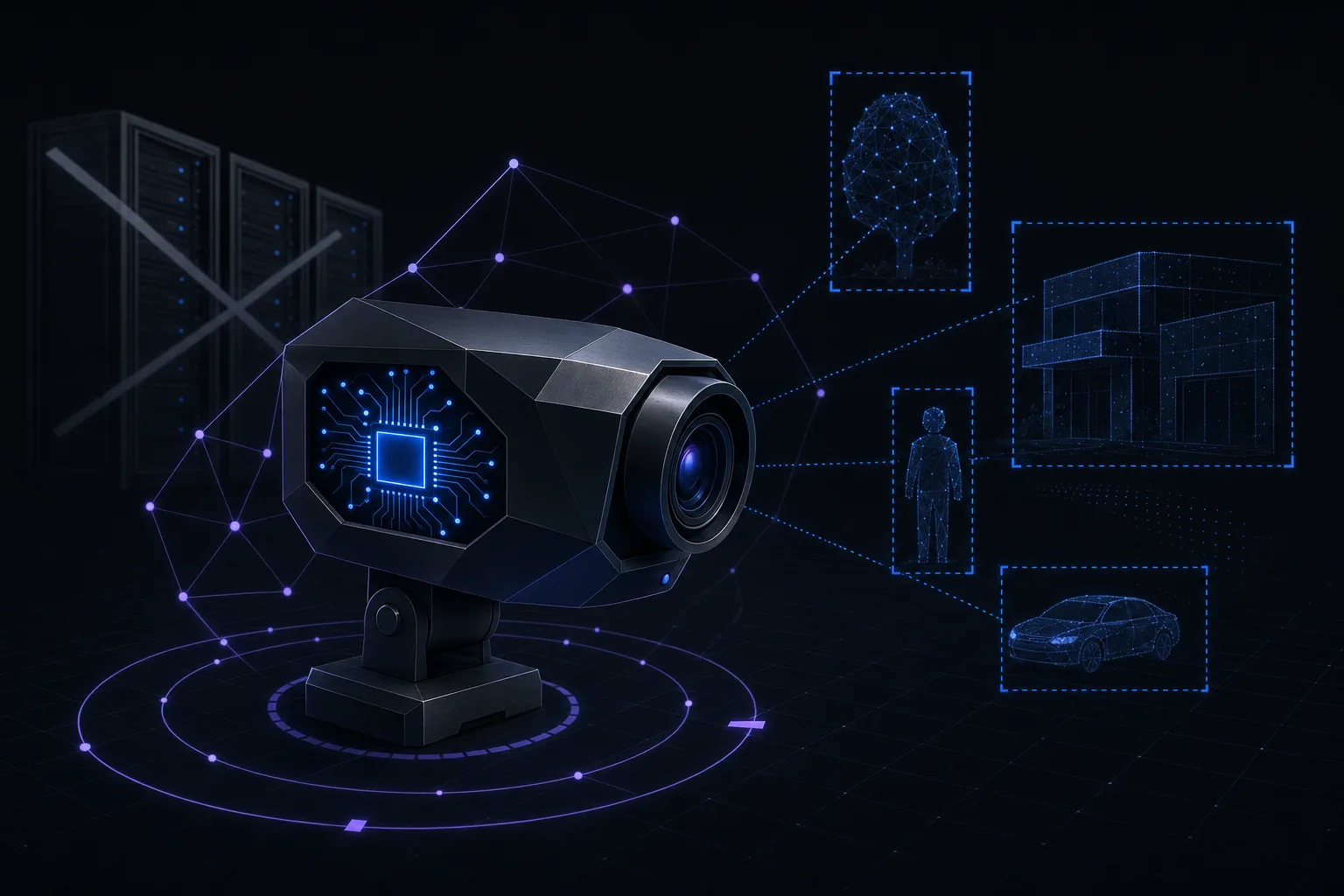
For two decades, video analytics meant server-side processing. Cameras captured raw video, streamed it across the network to a centralized server, and dedicated GPU hardware performed object detection, classification, and tracking. This architecture worked, but it consumed enormous bandwidth, required expensive server infrastructure, and scaled poorly. When a 200-camera deployment needed analytics on every feed simultaneously, the compute costs and network requirements became prohibitive.
Edge AI analytics represents a fundamental architectural shift. The intelligence moves from the data center to the camera itself, where a dedicated neural processing unit (NPU) or system-on-chip (SoC) performs inference on the raw video before it ever touches the network. The camera transmits only metadata and event-triggered clips instead of continuous full-resolution streams. The implications for bandwidth, storage, latency, and system cost are transformative.
Architectural Comparison: Server-Side vs. Edge Analytics
Understanding the tradeoffs between server-side and edge-based analytics is essential for making the right architectural decision for each deployment. Neither approach is universally superior. The correct answer depends on the use case, camera count, network constraints, and the sophistication of the analytics required.
| Metric | Server-Side Analytics | Edge Analytics |
|---|---|---|
| Network bandwidth per camera | 6-15 Mbps (continuous stream) | 0.5-2 Mbps (metadata + event clips) |
| Latency (detection to alert) | 500 ms - 3 seconds | 50-200 ms |
| Server GPU requirement | NVIDIA T4/A2 per 15-30 cameras | None (processing on-camera) |
| Scalability ceiling | Limited by server GPU capacity | Linear: each camera is self-contained |
| Model complexity | Large models (YOLOv8-XL, transformers) | Optimized models (MobileNet, quantized YOLO) |
| Failure impact | Server failure = all cameras lose analytics | Camera failure = only that feed affected |
| Cost per channel (hardware) | $50-150 amortized server cost | $0 incremental (built into camera SoC) |
The bandwidth reduction is the metric that usually drives the business case. A 4MP camera streaming H.265 at 20 fps typically consumes 8-12 Mbps. When edge analytics is enabled, the camera can send a low-bitrate overview stream (1-2 Mbps) for live monitoring and only transmit full-resolution clips on detection events. For a 100-camera deployment, this reduces sustained network throughput from 1 Gbps to under 200 Mbps, potentially eliminating the need for a 10GbE backbone to the recording server entirely.
SoC Processors Powering Edge Intelligence
The edge AI revolution was enabled by specialized silicon. Modern security cameras embed system-on-chip processors with dedicated neural network accelerators that can run inference on every frame at full resolution while simultaneously encoding and streaming video. The three dominant SoC families in the security industry each offer different performance profiles.
- Ambarella CV series (CV22, CV25, CV28, CV52, CV72): Ambarella dominates the mid-to-high tier security camera market. The CV25 delivers up to 4 TOPS (tera operations per second) of neural network performance while encoding 4K video at 30fps. The CV72, their latest generation, pushes 20+ TOPS and supports transformer-based models. Ambarella's CVflow architecture is optimized for convolutional neural networks with hardware support for common layers like depthwise separable convolutions used in MobileNet architectures.
- HiSilicon (Kirin/Ascend series): HiSilicon processors power a large percentage of cameras from Chinese manufacturers. Despite trade restrictions limiting their availability in some markets, their installed base remains massive. The Hi3559A and successor chips offer competitive TOPS performance at aggressive price points. However, supply chain uncertainty and geopolitical considerations make them a risk factor in long-term deployments for North American clients.
- NVIDIA Jetson platform (Nano, Xavier NX, Orin Nano/NX): While not a traditional camera SoC, NVIDIA Jetson modules are integrated into high-end analytics cameras and edge appliances. The Orin NX delivers up to 100 TOPS, enabling complex multi-model pipelines that can run person re-identification, license plate recognition, and behavior analysis simultaneously on a single unit. The Jetson ecosystem benefits from CUDA compatibility, allowing desktop-trained models to deploy to edge with minimal modification.
ONNX, OpenVINO, and Model Deployment Workflows
Training a neural network on a workstation GPU is only half the challenge. Deploying that model to a resource-constrained edge device requires conversion, optimization, and quantization. The industry has converged on several standard model interchange formats that bridge the gap between training frameworks and edge inference engines.
ONNX (Open Neural Network Exchange) has become the lingua franca of edge model deployment. A model trained in PyTorch or TensorFlow can be exported to ONNX format and then optimized for the target SoC's inference engine. For Ambarella chips, the ONNX model is compiled through their toolchain into a CVflow binary. For Jetson devices, TensorRT optimizes the ONNX graph with layer fusion, kernel auto-tuning, and INT8 quantization. Intel OpenVINO serves a similar role for deployments on Intel-based edge devices and is widely used in VMS analytics plugins.
Quantization, the process of converting 32-bit floating-point model weights to 8-bit integers, typically reduces model size by 4x and increases inference speed by 2-3x with minimal accuracy loss, often less than 1% mAP degradation on common detection benchmarks. For security applications where the difference between 92% and 91% detection accuracy is operationally irrelevant, INT8 quantization is a best practice that should be applied to every edge deployment.
Analytics Capabilities at the Edge
The range of analytics that can run on-camera has expanded dramatically with each SoC generation. What required a dedicated server rack five years ago now runs in a camera that draws under 15 watts via PoE.
- Object classification: Distinguishes between people, vehicles, animals, and other objects. This is the foundation of false alarm reduction because motion detection triggers can be filtered to only alert on human or vehicle targets, eliminating 90%+ of nuisance alerts caused by trees, shadows, insects, and weather.
- License plate recognition (LPR/ANPR): Edge-based LPR uses OCR neural networks to read plates in real time, logging entries in a local database and transmitting plate reads as metadata events. The camera sends a plate number, confidence score, timestamp, and a cropped plate image rather than a continuous video stream for server-side processing.
- People counting and occupancy: Bidirectional counting at doorways and corridors using overhead cameras. Edge processing delivers real-time occupancy data via MQTT or REST API for integration with building management systems, digital signage, and access control occupancy limits.
- Behavioral analytics: Loitering detection (person stationary in a zone beyond a time threshold), line crossing (directional tripwire), abandoned object detection, and crowd density estimation. These rule-based analytics combined with neural network classification provide actionable security alerts with low false alarm rates.
False Alarm Reduction Is the Killer App
The single most impactful application of edge AI in security is not a new analytics type but rather the refinement of an existing one: motion detection. Traditional pixel-based motion detection generates dozens of false alarms daily from environmental factors. Edge AI classification reduces actionable alerts to only those involving humans or vehicles, cutting false alarm rates by 90-98%. For monitoring stations that charge per alarm response, this reduction pays for the camera upgrade within months.
Metadata Integration via ONVIF Profile M
ONVIF Profile M, ratified in 2022, standardizes how cameras communicate analytics metadata to video management systems and other clients. Before Profile M, each camera manufacturer used proprietary APIs and event formats, forcing VMS vendors to write custom integrations for every camera line. Profile M defines a common metadata schema for analytics events including object type, bounding box coordinates, classification confidence, tracking ID, and event timestamps.
For integrators, Profile M compliance means that an edge analytics camera from Axis can send person detection events to a Milestone or Genetec VMS using a standardized interface, without requiring manufacturer-specific plugins. This is not yet universal, as many camera and VMS combinations still rely on proprietary integrations for advanced features. But for basic object detection events, Profile M is rapidly becoming the expected baseline. Specify ONVIF Profile M support in all camera submittals for projects where multi-vendor interoperability is a requirement.
Edge Storage and Privacy Masking
Edge analytics cameras with onboard SD card or M.2 NVMe storage can record analytics events locally, providing a decentralized recording architecture that continues operating even if the network connection to the VMS is lost. This edge recording capability is particularly valuable for cameras on unreliable wireless links or in branch office locations with limited bandwidth to a centralized recorder.
Privacy masking at the edge is another capability enabled by on-camera processing. The neural network identifies people in the field of view and applies dynamic masking, either blackout or pixelation, before the video stream leaves the camera. The unmasked original never traverses the network or reaches the recording server. For deployments subject to GDPR, state privacy laws, or corporate policies that restrict surveillance of public areas adjacent to the property, edge-based privacy masking provides a technical enforcement mechanism that is stronger than any policy document.
Designing for the Edge-First Future
Edge AI analytics is not a future technology. It is the present standard for any security deployment designed in 2025 or beyond. The cameras with the most advanced SoCs cost only marginally more than their non-analytics counterparts, and the savings in network infrastructure, server hardware, and reduced false alarm response costs dwarf the incremental camera expense. The key design decisions are selecting cameras with capable SoCs and open model deployment pipelines, ensuring adequate PoE power for the additional processing load, and specifying ONVIF Profile M or equivalent metadata integration with your chosen VMS platform.
Zimy Electronics designs edge-first video analytics architectures that maximize detection accuracy while minimizing infrastructure cost. From SoC selection and camera specification to VMS metadata integration and bandwidth planning, our engineering team builds analytics deployments that deliver actionable intelligence without the server farm. Whether you need perimeter intrusion detection, LPR, people counting, or multi-site analytics with centralized dashboards, we architect the system to perform at the edge.