NEC Conduit Fill: The Integrator's Reference for Low-Voltage Pathways
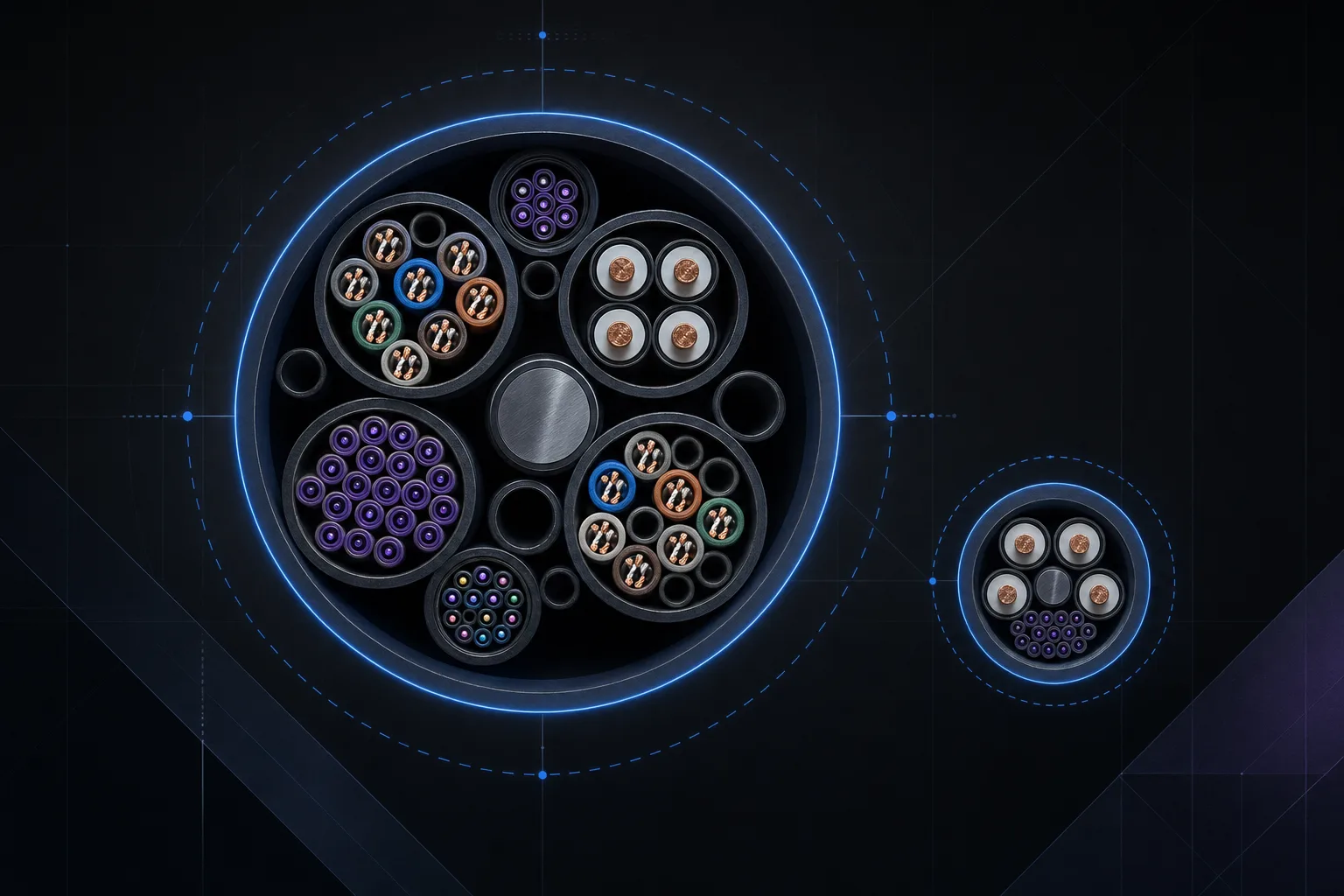
Every low-voltage cable needs a pathway, and most pathways involve conduit. Whether you are pulling Cat6A to an exterior PTZ camera, running fiber backbone between telecom rooms, or routing access control wiring through a fire-rated wall, you must size that conduit correctly. Overfilling conduit damages cable jackets during installation, exceeds the bend radius of individual conductors, makes future cable additions impossible, and in many jurisdictions will fail inspection under NEC Chapter 9.
This reference guide covers NEC conduit fill requirements, cable area calculations, jam ratio, J-hook and cable tray considerations, and the separation requirements that keep your Class 2 low-voltage circuits compliant. It is written for the security integrator who needs to get conduit sizing right on the first submittal.
NEC Chapter 9 Table 1: Conduit Fill Percentages
NEC Chapter 9, Table 1 specifies the maximum percentage of a conduit's internal cross-sectional area that may be occupied by conductors or cables. These limits exist to prevent cable damage during pulling, allow adequate heat dissipation, and ensure that future cables can be added. The percentages apply to the total cable cross-sectional area including the jacket, not just the conductor copper.
| Number of Cables | Maximum Fill % | Practical Application |
|---|---|---|
| 1 cable | 53% | Single large cable such as 24-strand fiber or multi-pair backbone |
| 2 cables | 31% | Most restrictive; two cables jam easily due to geometry |
| 3 or more cables | 40% | Standard fill for bundles of Cat6, Cat6A, or composite cables |
The 31% fill ratio for two cables is often surprising to new integrators. It is actually more restrictive than three or more cables because two round cables in a circular conduit tend to sit side by side, creating a jam condition where neither cable can move past the other during pulling. Three or more cables arrange themselves in a triangular or cradled configuration that allows smoother movement through the raceway.
Conduit Trade Size Reference for Common Low-Voltage Cables
The following table provides the maximum number of common low-voltage cables that fit in standard EMT conduit trade sizes, calculated using the 40% fill ratio per NEC Chapter 9 Table 1 for three or more conductors. Cable outside diameters are based on typical manufacturer specifications.
| EMT Trade Size | Internal Area (sq in) | Cat6 (0.25" OD) | Cat6A (0.30" OD) | RG59 Coax (0.24" OD) |
|---|---|---|---|---|
| 3/4" | 0.213 | 6 | 3 | 6 |
| 1" | 0.346 | 10 | 6 | 10 |
| 1-1/4" | 0.598 | 17 | 11 | 18 |
| 1-1/2" | 0.814 | 23 | 15 | 25 |
| 2" | 1.342 | 38 | 24 | 41 |
| 3" | 2.907 | 83 | 52 | 89 |
Note that Cat6A cables have a significantly larger outside diameter than Cat6, typically 0.29 to 0.35 inches depending on manufacturer and whether the cable uses a spline or tape separator. Always use the actual OD from the specific cable manufacturer's datasheet, not a generic value. A few hundredths of an inch difference in OD can change the conduit size requirement on a 20-cable pull.
Performing Cable Area Calculations
The calculation is straightforward geometry. The cross-sectional area of a round cable is pi times the radius squared, or equivalently pi times the diameter squared divided by four. For a Cat6A cable with a 0.30-inch outside diameter, the area is 3.14159 times 0.09 divided by 4, yielding 0.0707 square inches. Multiply by the number of cables to get the total cable area. Then compare to the allowable fill area of your conduit, which is the conduit's internal cross-sectional area times the applicable fill percentage from Table 1.
For example, 10 Cat6A cables at 0.0707 square inches each yield a total cable area of 0.707 square inches. A 1-1/2 inch EMT conduit has an internal area of 0.814 square inches. At 40% fill, the allowable cable area is 0.326 square inches. Ten Cat6A cables far exceed this, requiring a jump to 2-inch EMT with 0.537 square inches of allowable fill area. That is still not enough. You would need a 2-1/2 inch or 3-inch EMT. This is why Cat6A deployments consistently require larger conduit than what Cat5e or Cat6 installers are accustomed to.
Always Calculate for Growth
BICSI TDMM (Telecommunications Distribution Methods Manual) recommends sizing conduit for no more than 60-70% of the NEC maximum fill to allow for future cable additions. On a new construction project, adding one trade size to your calculated minimum is inexpensive during rough-in but prohibitively costly as a retrofit. A 2-inch conduit costs pennies more than a 1-1/2 inch during installation but can accommodate 60% more cables when the client adds cameras three years later.
Understanding Jam Ratio
Jam ratio is the conduit's internal diameter divided by the cable's outside diameter. When this ratio falls between 2.8 and 3.2, the cables are prone to jamming in a triangular configuration where they wedge against each other and the conduit wall, making pulling extremely difficult and risking jacket damage. The ideal jam ratio is either below 2.0 (cables stack predictably) or above 3.5 (cables have enough room to rearrange freely).
For three Cat6A cables with a 0.30-inch OD in a 1-inch EMT conduit with a 1.049-inch ID, the jam ratio is 1.049 divided by 0.30, which equals 3.50. That is right at the edge of the jam zone. Upsizing to 1-1/4 inch EMT with a 1.380-inch ID gives a jam ratio of 4.60, well clear of the danger zone. Always check jam ratio when pulling exactly three cables in a conduit, as this is the configuration most susceptible to jamming.
EMT, Rigid, and Flexible Conduit: Fill Differences
The NEC fill percentages in Table 1 apply to all conduit types, but the internal dimensions differ. Rigid metal conduit (RMC) and intermediate metal conduit (IMC) have slightly different internal diameters than EMT for the same trade size. The fill tables in NEC Chapter 9, Tables 4 and 5, provide the exact internal areas for each conduit type. Always use the correct table for your conduit type.
Liquidtight flexible metal conduit (LFMC) and liquidtight flexible nonmetallic conduit (LFNC) are commonly used for the final connection to outdoor cameras and for transitions between rigid pathway segments and equipment. Their internal diameters are typically smaller than EMT for the same trade size due to the corrugated construction. NEC Chapter 9, Table 4 includes separate columns for these conduit types. A common mistake is to assume that 3/4-inch LFMC has the same fill capacity as 3/4-inch EMT. It does not. The internal area of 3/4-inch LFMC is approximately 0.17 square inches versus 0.213 for EMT.
J-Hook Spacing and Cable Tray Fill
Not all pathways are conduit. Open cable pathways using J-hooks and cable trays are common in above-ceiling and data center environments. BICSI TDMM specifies J-hook support spacing at 4 to 5 feet (1.2 to 1.5 meters) for horizontal cable runs. Each J-hook should support no more than the quantity of cables that can rest in the hook without being compressed or kinked. For a 2-inch J-hook, this is typically 20 to 25 Cat6 cables or 15 to 18 Cat6A cables.
Cable tray fill for Class 2 and Class 3 circuits is governed by NEC Article 392 and supplemented by TIA-569 pathway standards. Unlike conduit, cable tray fill is measured by cross-sectional depth rather than percentage of area. The cables must not be stacked higher than the tray sidewall. For security cable trays carrying mixed cables including Cat6A, composite access control cable, and speaker wire, maintaining visible organization with Velcro straps or tray dividers prevents crosstalk issues and simplifies troubleshooting.
NEC Article 725 and Pathway Separation from Power
NEC Article 725 governs Class 1, Class 2, and Class 3 remote-control, signaling, and power-limited circuits, which encompasses the vast majority of security system wiring. Class 2 circuits, which include PoE cables, access control data circuits, and most sensor wiring, must be physically separated from power circuits operating at 50 volts or higher unless specific exceptions apply.
- In conduit: Class 2 cables may not share a conduit with power conductors. Period. No exceptions based on barrier or partition. This is one of the most frequently violated provisions in low-voltage installations, especially when a 120V outlet and a security camera cable are run to the same location.
- In cable tray: Class 2 cables may share a cable tray with power cables if separated by a fixed barrier. TIA-569 further recommends a minimum of 2 inches (50 mm) of physical separation even with a barrier in place to prevent electromagnetic interference.
- In open pathways (J-hooks): Low-voltage cables on J-hooks must maintain separation from parallel power runs. TIA-569 Table 7 specifies minimum separation distances: 5 inches from unshielded power up to 2 kVA, 12 inches from 2-5 kVA, and 24 inches from sources over 5 kVA such as motor loads and fluorescent ballasts.
Innerduct for Fiber in Shared Pathways
When fiber optic cables share a conduit with copper cables, best practice is to install the fiber in a continuous innerduct. Innerduct protects the fragile fiber jacket from damage during subsequent cable pulls, and it provides a dedicated sub-pathway that allows the fiber to be replaced independently without disturbing the copper cables. Standard 1-inch innerduct in a 2-inch or larger EMT conduit is the typical configuration for low-voltage backbone runs that include both fiber and copper.
When calculating conduit fill with innerduct, treat the innerduct as a cable with its full outside diameter. A 1-inch innerduct with a 1.06-inch OD in a 2-inch EMT reduces the available area for copper cables significantly. Plan accordingly and consider running separate conduits for fiber and copper on long backbone runs.
Getting Pathway Design Right
Conduit fill calculation is not the most exciting part of security system design, but it is one of the most consequential. An undersized conduit means damaged cables, failed inspections, and expensive retrofits. An oversized conduit costs slightly more at rough-in but provides flexibility for the life of the building. Do the math, check the jam ratio, respect the NEC fill percentages, and always design for growth.
Zimy Electronics provides detailed pathway design as part of every project we deliver. From conduit fill calculations and J-hook layouts to fiber innerduct specifications and TIA-569 separation compliance, our engineering team ensures your low-voltage infrastructure meets code requirements and accommodates future growth. We submit pathway drawings with cable fill schedules so there are no surprises during rough-in or inspection.